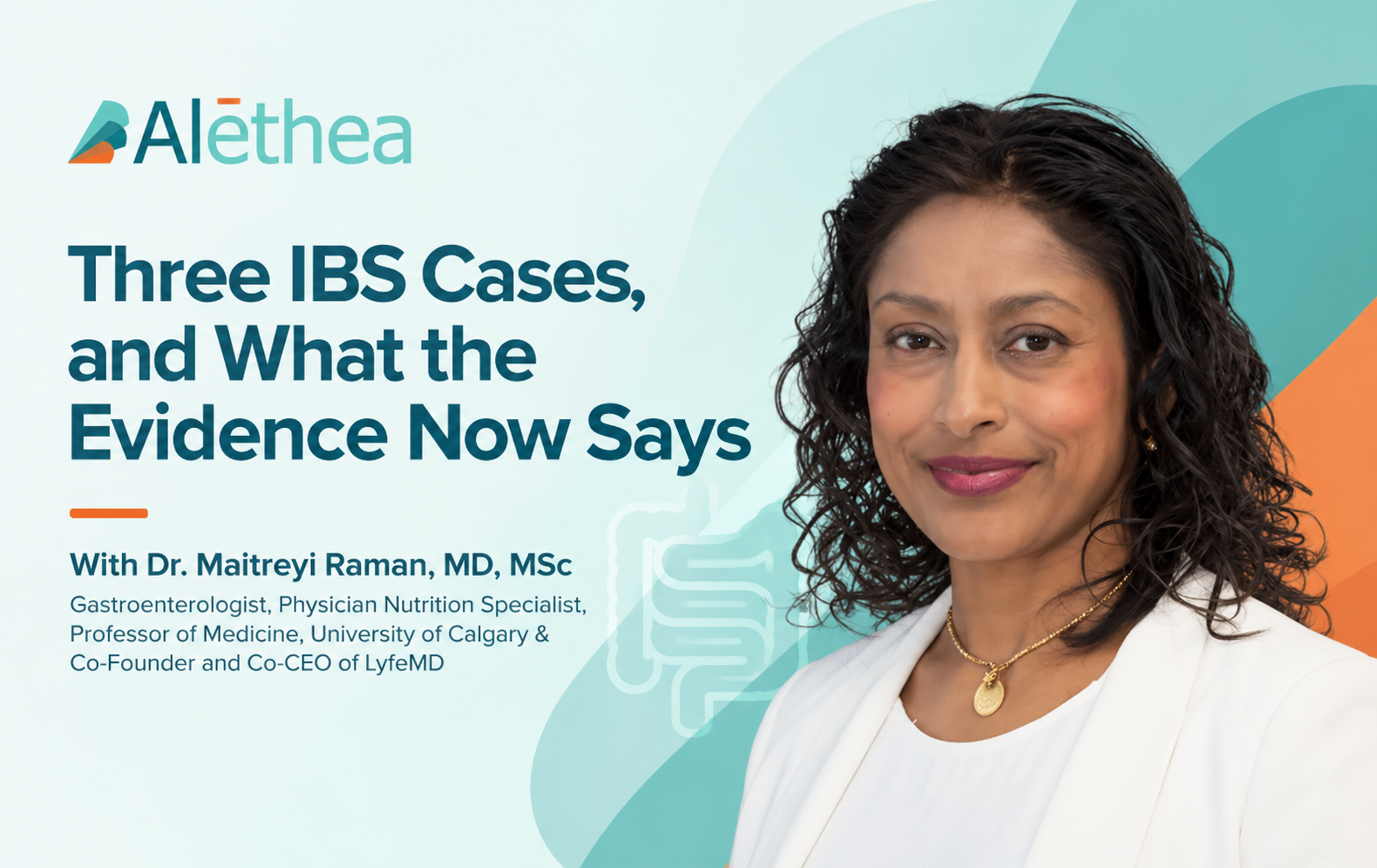
Three IBS Cases, and What the Evidence Now Says: Key Takeaways from Dr. Maitreyi Raman
Irritable Bowel Syndrome (IBS) is one of the most common gastrointestinal conditions encountered in primary care, yet its diagnosis and management can present challenges for both providers and patients.
In our recent Alethea Learning Session, Dr. Maitreyi Raman, Gastroenterologist, Physician Nutrition Specialist, Professor of Medicine at the University of Calgary, and Co-Founder and Co-CEO of LyfeMD, explored evidence-based approaches to IBS through three clinical cases.
The session focused on constipation-predominant IBS (IBS-C), diarrhea-predominant IBS (IBS-D), and mixed IBS (IBS-M), highlighting practical strategies for diagnosis, treatment, and ongoing patient support.
IBS-C: Making a Confident Diagnosis
One of Dr. Raman's key messages was that IBS should be approached as a positive diagnosis rather than a diagnosis of exclusion.
For patients who meet Rome IV criteria, have reassuring basic investigations, and present without alarm features, extensive testing is generally unnecessary.
Dr. Raman discussed appropriate initial investigations, including CBC, ferritin, celiac serology, and TSH, while emphasizing the importance of recognizing symptoms that warrant further assessment.
For IBS-C management, soluble psyllium fibre is an evidence-based first-line option, with additional therapies considered based on patient response.
She also emphasized the importance of explaining IBS as a disorder of gut-brain interaction, helping patients better understand their symptoms and the rationale behind treatment recommendations.
IBS-D: When Treatment Isn't Working, Reconsider the Diagnosis
For patients with persistent diarrhea despite treatment, Dr. Raman encouraged providers to revisit the diagnosis rather than simply repeat unsuccessful therapies.
Conditions such as bile acid diarrhea, inflammatory bowel disease, microscopic colitis, and infectious causes should be reconsidered when symptoms do not respond as expected.
Another important discussion centred on the low-FODMAP diet.
While it can be effective for IBS symptom management, Dr. Raman emphasized that it should not become a permanent restrictive diet. Instead, it should follow a structured approach involving short-term restriction, systematic food reintroduction, and personalization, ideally with dietitian support.
IBS-M: Understanding the Gut-Brain Connection
For patients experiencing mixed bowel symptoms and persistent abdominal pain, Dr. Raman highlighted the importance of addressing the gut-brain connection.
Evidence-based approaches such as IBS-specific cognitive behavioural therapy (CBT), gut-directed hypnotherapy, mindfulness, and other behavioural interventions can play an important role in managing symptoms.
These therapies should be considered as part of comprehensive IBS care rather than reserved exclusively for patients who have exhausted other treatment options.
Extending IBS Care Beyond the Clinic with LyfeMD
Effective IBS management often requires ongoing education, dietary guidance, and behavioural support that can be difficult to provide during a routine primary care appointment.
To help address this gap, Dr. Raman introduced LyfeMD's IBS Mastery Program, a free four-week group program focused on nutrition, the gut-brain connection, and physical activity.
The program offers structured support for patients managing persistent IBS symptoms and can complement the care they receive from their primary care provider.
Alethea users can refer patients directly to LyfeMD through the Non-Insured Services Network by selecting Send Non-Insured Service Referral and searching for LyfeMD IBS Dietitian Services.
Explore the Full Learning Notes
Dr. Raman's session offered valuable clinical insights into diagnosing IBS confidently, recognizing when further investigation is needed, and incorporating evidence-based dietary and gut-brain therapies into patient care.
For a more detailed breakdown of all three clinical cases, treatment considerations, and practical recommendations for primary care, we encourage you to explore the complete session notes.
Click Here to Read the Full Learning Notes
More from Alethea